top of page
  • Facebook
  • Instagram
  • YouTube
  • TikTok
  • X

In The SpotLyght Feature Magazine

Ask any young person what they want to be when they grow up and you most likely will get lofty answers, such as a pro-football player or a You Tube star. While admirable, it may be worthwhile to temper these expectations and get kids thinking about a Plan B that incorporates their dreams into the real world.

Enter Junior Achievement (JA), a non-profit organization that is celebrating its 100th anniversary.

Since 1919, JA has made it its mission to prepare youth for future jobs by helping young people understand business and finance so that they are “work-force ready.”

Currently, the JA network reaches approximately 5 million students a year in the United States, and 10 million students in total in more than 100 countries.

To understand its current mission, we have to look at the organization’s history, which began as the Boys’ and Girls’ Bureau of the Eastern States League, founded by AT&T chairman Theodore Vail, Strathmore Paper Company founder Horace Moses, and Massachusetts Senator Murray Crane.

Today, JA aims to educate youth with the knowledge and skills to achieve economic success in a variety of ways, whether that means going to college, starting a business, or learning a trade. JA programs are taught by volunteers whose goal is to help students make smart academic and economic choices as they plan for their futures.

According to the organization, “Junior Achievement’s programs – in the core content areas of work readiness, entrepreneurship and financial literacy – ignite the spark in young people to experience and realize the opportunities and realities of work and life in the 21st century.”

JA began in 1919 with a focus on younger students, but shifted focus to after-school programs for high-schoolers who were encouraged to start student-run businesses with guidance from volunteer business advisors in the community.

However, JA expanded its reach to include younger children in financial education in the 1970s.

Project Business, a program aimed at teaching business concepts to middle-schoolers during in-classroom sessions, and Business Basics, a program for elementary school children taught by volunteers from the high school programs, were introduced. By the 1990s, JA had developed in-school programs for grades K-12 in the United States.

JA’s international expansion began in the 1950s with the opening of an office in Canada, followed by the first overseas Junior Achievement-affiliated organization, Young Enterprise (YE), in the United Kingdom in the 1960s.

JA Worldwide currently provides volunteer-run programs in countries throughout the world.

“Today, JA is pushing the education envelope with the implementation of blended-learning, augmented reality and project-based programs,” according to a company statement.

Current programs include simulations in which elementary and middle school students have the opportunity to test out making adult financial decisions or manage a town.

In addition, high school students have opportunities through JA to shadow professionals on the job in a variety of fields.

Visit JA.org to get more information about the programs, to donate, or to volunteer.

The answer is: Yes, it’s expected.

But it’s also a chance for brides to truly show that not everything is about them on the BIG DAY. That there really is another person involved (that would be the groom) who deserves a bit of recognition, too.

We’re talking wedding presents — specifically, yours to your husband-to-be.

Tradition does, indeed, hold that both you and he exchange gifts. And while it’s true that some grooms are initially shocked to learn your engagement ring doesn’t also count as a “pre-sent,” that’s no excuse for you, the bride, to forgo a gift to your new hubby.

“Giving him something that’s just for him will make him feel really special,” advises BrideBox.com.

Here’s what you need to know, now that prime wedding season is upon us:

• There’s a time and place. Etiquette dictates that the hand-off occurs at one of three times: the night before the wedding, the morning of the ceremony or right before leaving on your honeymoon. Think it’s still bad luck to see the groom before the nuptials? There are ways around this. “Many couples choose to courier gifts via bridesmaids or groomsmen just before the ceremony,” says brides.com.

• There’s a thin line between “romantic” and “mushy.” Some may be tempted to com-pile a “love notes” journal of every bit of correspondence they’ve received from the groom. Even assuming he’s the type who would appreciate such a gift, there’s always the off chance he might be left wondering, “Okay, where’s my real present?” — especially if his gift to you is a serious piece of jewelry.

• There is the consensus choice. There’s a reason a watch invariably makes everyone’s short list: It’s the perfect statement of who he is or aspires to be. (It’s also a lot more impressive than a flask, which for some reason also makes the top ten in gift giving.)

No less a taste arbiter than MarthaStewartWeddings.com favors Baume & Mercier’s Clif-ton line — as elegant as the original 1950s model that inspired it — for the way it “easily transitions from big day to every day.” Like the Swiss watchmaker’s timelessly charming (and affordably luxurious) Classima line, it comes with a choice of straps, dial faces and a variety of what’s known as “small complications” that go way beyond just telling the hour. You can shop them at Baume&Mercier e-boutique or by calling 1-800-MERCIER, where free engraving and wrapping are available.

• There’s something to remember. One writer at AskMen.com says he’s “heard of women giving their husbands watches in the ceremony instead of a wedding ring.” If so, the answer: No, just like your engagement ring, that, too, would not qualify as a wedding present.

By Morris Raymond

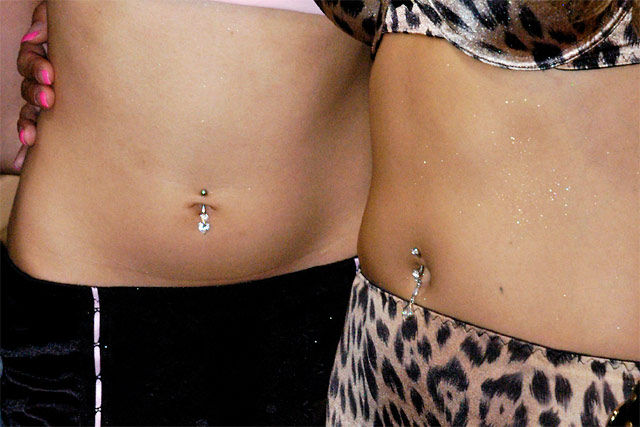
As someone who has been fascinated by all forms of body art my entire life, I’ve been drawn into the world of body art’s history. I’m fascinated by the cultural and spiritual impact body art can have, and I can honestly say that belly button piercing is something that really intrigues me more than most types of body art.

For starters, I think that this type of piercing looks really cool, and in the right context can be very alluring. Moreover, for the truly artistic individuals out there, a belly button piercing can be the crowning piece necessary to take a body art project to new heights. In short, these piercings rock.

Then again, this type of piercing tends to be seen as more of a novelty and a cosmetic decoration. It can often carry less-than-savory connotations for the person donning the piercing, and the belly button piercing tends to be seen as a high-school and college girl crowd type thing that no self-respecting adult would find admirable to have.

It is this wide spectrum of opinion about a belly button piercing that prompted me to learn a little more about the procedure, and for all of the body art fanaticism that I claim, it turns out that I learned a thing or two.

Here are a few things I learned about belly button piercing that might surprise you, too:

Gauge of Jewelry Is Important – A 14g tends to be the standard width of the piercing jewelry, with occasional piercer using thinner jewelry. The standard tends to be seen as the way to go, especially to help keep issues from developing during the healing process.

Healing Can Take A Long Time – You might be surprised to know that healing can take somewhere between four months to one year, depending on your source.

Your Piercer Needs to be Trusted – It can be tempting to just get a belly button piercing from someone who says they’ve done it, especially if you’re a spur-of-the-moment type of person. Resist this urge, and do some research on piercers in your area.

Pain Can Vary Quite A Bit – Will It Hurt? It depends. Not everyone handles pain the same way, so truth be told, there’s no way to peg an actual answer down. That said, assume you’re going to feel some discernible pain.

Every Belly Button Is Different – Whether you’re talking about an innie or outie, or talking about the way the skin above & below your belly button presents itself, not every piercing is the same. This means that your experience won’t be the same as your BFF, so think a piercing through.

A belly button piercing is a low-key entry into the world of body art and one that, for all of the back and forth about what message about you it conveys, ultimately says what you want it to say. That said, put in the work in finding the best piercer you can with the right credentials, experience, and satisfied clients. And, of course, don’t rush into things.

bottom of page